NYC Midnight Challenge – 250 words – First Round – Only Ashes to Mourn

Only Ashes to Mourn

December 2025 (First Round)
Genre: Historical Fiction
Action: Quenching
Word: Other
Time Constraint: 48 hours
Length: 250 words

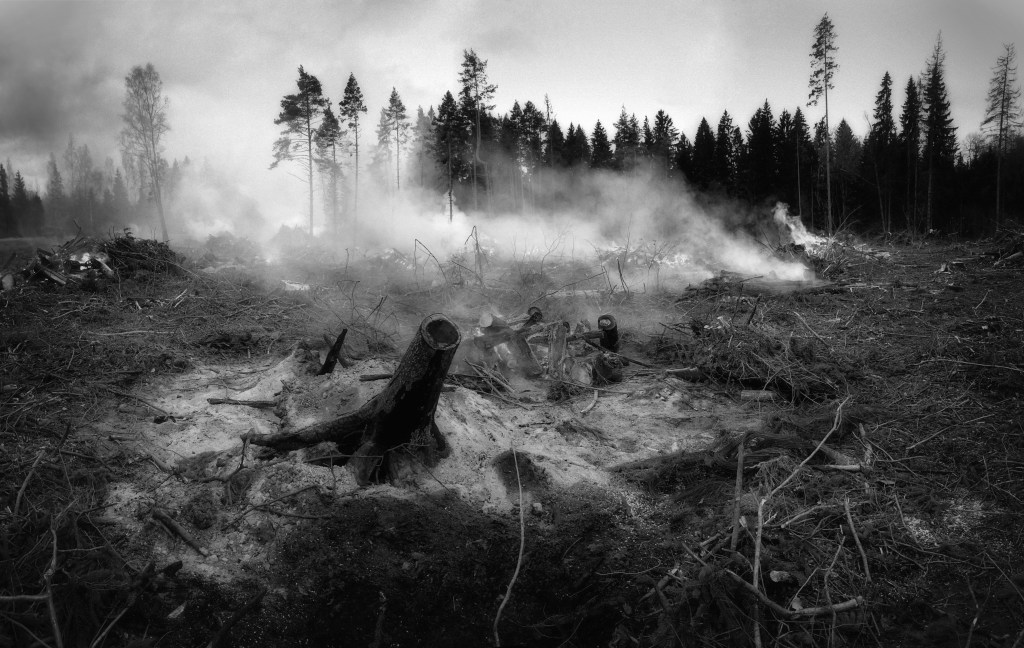
I smelled the fire before I saw it. But even with my lips chapped by drought, I paid the wind’s taint no mind. The evening chill required our hearths to warm our stews and our bones.

But the screams from the railroad were undeniable—the glow on the horizon much too late for sunset. The flames leapt from tree to tree with wicked speed, like demons racing from hell to claim us.

Peshtigo came alive with panicked shrieks. Adrenaline blotting out all else, I raced for Beth’s house. Though we had yet to speak our vows, if the reaper was to find us, I wanted to be at her side. We crashed together on main street, the flames already licking at the roofs around us—the tears on her face glowing in the inferno.

Smoke clogged our lungs and embers peppered our skin. Elizabeth’s skirt caught flame, and in desperation, I dragged her to the well. She sobbed as I lowered her down, praying she’d survive the fall. She dropped with a splash and a hiss, the icy, knee-high water quenching her smoldering dress. I clambered after her, and we clutched one another through the night. The cold nearly killing us in hateful irony.

But perhaps the greatest irony of all was that the headlines would only remember Chicago’s flames on that same October day.

I suppose because Chicago still had people to grieve her losses.

In the mass graves of Peshtigo, there weren’t enough left of us to mourn.


Unfortunately, this one didn’t place, but the feedback is below!

WHAT THE JUDGES LIKED ABOUT YOUR STORY

{2501} The description throughout this story is so vivid and creates powerful images of these devastating events, allowing for a strong emotional impact. You do a great job describing feelings of fear and the terrifying sensation of running through a burning town. Elizabeth’s skirt catching fire is a particularly effective moment of building tension before it’s revealed that the narrator saves her by getting her into the well. I also thought the comparison at the end of how Chicago’s fire is remembered more even with less deaths was a powerful ending to further showcase just how tragic this event was. Overall, some of my favorite lines throughout the story include “The flames leapt from tree to tree with wicked speed, like demons racing from hell to claim us” and “Smoke clogged our lungs and embers peppered our skin.”

{2373} There’s a truly haunting story here. The author brings the horrors of the Peshtigo fire and this narrator’s plight to life through active, sharp prose. The second paragraph alone is truly horrific and paints great images of the conflagration, namely the “screams from the railroad” and the flames leaping “like demons racing from hell to claim us.” I also like how in addition to the immediate and broader external stakes for the community, the author’s woven in the personal and emotional ones with the narrator’s desperate efforts to save Elizabeth. The description of her in the well yet again highlights the author’s powerful prose (along with the irony of the cold being an antagonist): “She dropped with a splash and a hiss, the icy-knee high water quenching her smoldering dress.” Lastly, the coda works well on several levels: It both highlights the narrator’s understandable anger, while also deftly reminding us about the more famous fire that’s consumed Chicago.

{2458} Wow—your story gripped me from beginning to end with its visceral sensory imagery, use of suspense, and final note of historical irony by contextualizing the tragedy in global awareness (or the lack thereof). I especially enjoyed how you transitioned to this larger historical context with the clever parallel use of irony; just as Beth and the narrator leap from the flames to the water, you leap seamlessly from Peshtigo to the media.

WHAT THE JUDGES FEEL NEEDS WORK

 {2501} The story could be even stronger with more personal resolution for Elizabeth and the narrator’s experience. Typically, we think of wells as being relatively deep, so I wondered if they were able to get out on their own come morning or if they had to be rescued by the few other survivors. If they needed help getting out, I think there could be power in the emotions of not knowing if there was anyone left to come help them. I also wondered if they suffered any personal losses in the fire, like family members or close friends. If so much of the population perished, it would make sense if they did, and I think seeing some of that grief at that end could be effective. To make room for these details in the word count, consider removing the first few sentences to start the story with “The screams from the railroad…”

{2373} To heighten the emotional stakes, I think it might be good to get more of a sense of why the narrator loves Beth. Given that this is a time of significant duress, that will help us see what the narrator could potentially lose in this conflagration. I also think it might be good to slow down and try to describe the increasing cold a tad more, so that we can feel that dark tension; I get that the word count limits make that tough, but I do think an additional line could heighten the terror of the cold on the page. On a micro level, I’d suggest a number of trims throughout. For example, in the second paragraph, I think the author could omit “wicked speed;” that’s clear from the emphasis on the flames leaping and in that great comparison to “demons racing from hell to claim us.” In the third paragraph, I would omit “panicked;” the shrieks strongly imply the sense of panic, given the situation. In the fourth paragraph, we also don’t need to be told that the narrator drags Elizabeth to the well “in desperation;” again, we can infer that because of her skirt’s on fire. I also think the author could omit “hateful irony” when describing how the narrator and Elizabeth almost perished. We can see that irony for ourselves; the story’s far more powerful if the author doesn’t point it out, along with directly telling us how ironic it was that Chicago burned on the same day; just mentioning Chicago alone shows us that irony, especially juxtaposed against the aftermath of Peshtigo (but that coda, again, otherwise works quite well). But I wish the author well! This piece has so much potential!

{2458} The primary feedback for improvement I have about your story regards this sentence: “Though we had yet to speak our vows, if the reaper was to find us, I wanted to be at her side.” Because the vows are never mentioned again, they felt a little ambiguous and a narrative thread left somewhat uncontextualized, and thus I think you should clarify that (I think) Beth and the narrator are engaged, to prevent any excess confusion; for me personally I only realized this after multiple reads. To make room for this relationship clarification, I recommend you cut down on some of the setup description on the fire, such as the demons comparison, which isn’t absolutely necessary to conveying the utter terror of the fire.


Thanks for reading! You can find the rest of my NYC Midnight Challenge entries and feedback here.
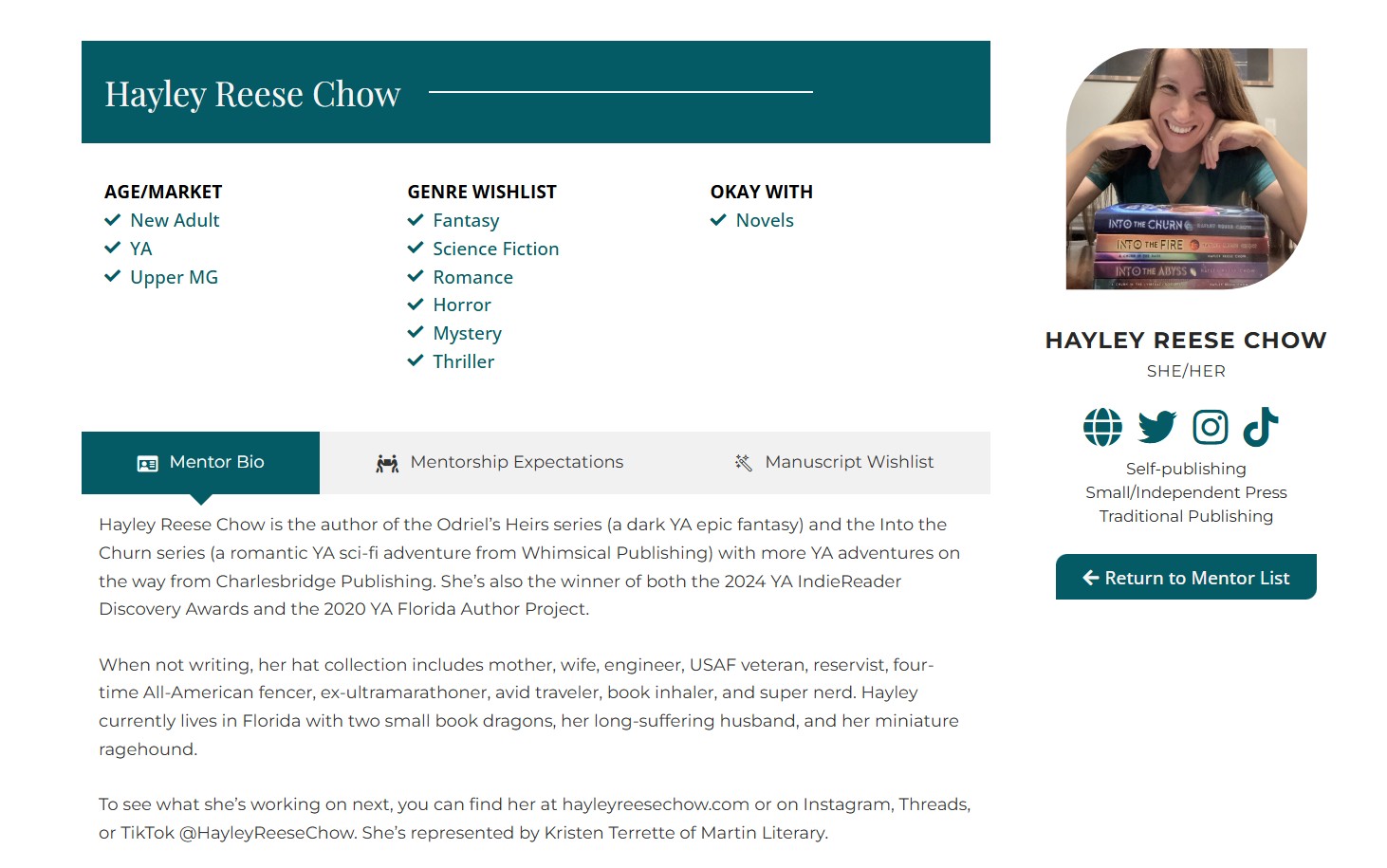
WriteHive Mentorship Program 2026!

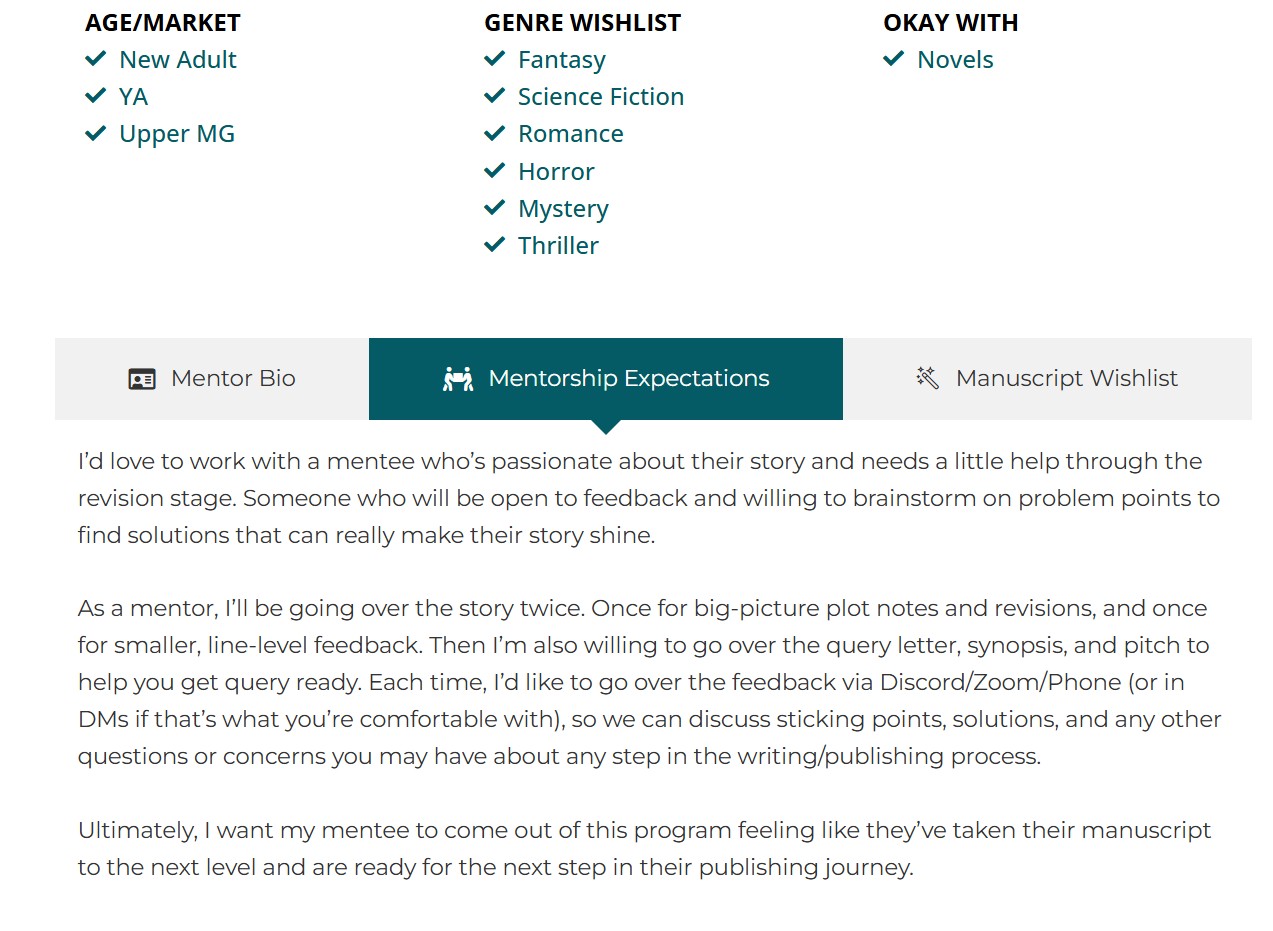
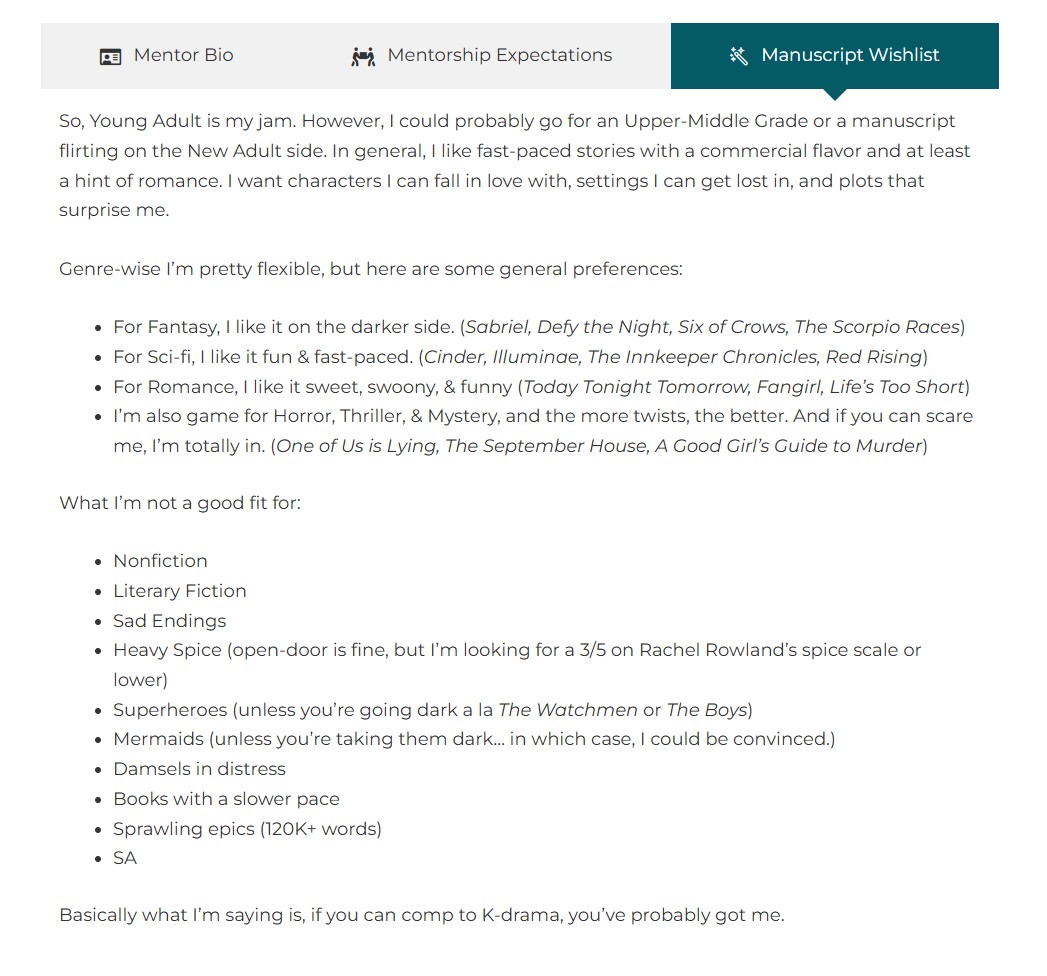
I’m so excited to announce I’ll be returning to the WriteHive Mentorship Program for my second year as a mentor. I had a great experience as a mentee in 2023, and again as a mentor in 2024, so I highly recommend this program to anyone looking for some help in whipping their manuscript into shape! I’ve included my mentor wishlist, profile and expectations below, but I highly recommend you check out all the mentor profiles here.

While you don’t submit to a specific mentor, I found it super helpful last year when applicants listed a few mentors they thought would be a good fit in their query/submission letters.

Also, if you’re curious as to what I’m looking for in submissions, you can find my breakdown of the submissions from last year here.

Last year, I went with Erin Scheuer‘s sweet new adult romantic comedy with YA crossover appeal which had huge K-drama vibes that I absolutely adored. But honestly this year, I’m pretty open when it comes to target audience and genre. There will be a Mentor AMA on WriteHive’s Discord & Bluesky next week if you have more questions, but if you’re on the fence about submitting, I hope you decide to take the leap!

Submissions will be open from Nov 14-16 and I can’t wait to see what comes in. If you’re submitting, good luck, and I’m excited to read your pitch!

Cheers friends and good luck!

Drabble Me This – The Office Clown

This was originally on a page on my website, but since I’ve mostly gotten out of writing flash fiction except for the NYC midnight challenge, I thought I’d move the little stories here instead. This one’s a microfic I wrote for the monthly 100 word story challenge years ago.

Image by Gerd Altmann from Pixabay

The office clown

I squint for a moment, then my eyes widen with recognition.  “Susan?”  The garish orange clown pockets her juggling balls, her painted smile faltering, but I press on.  “From accounting?” 

Her shoulders fold in as she looks down her red nose at the ground, looking just like she did when I caught her eating a cheap tv dinner in her cramped corner cube yesterday.  But in another beat, she straightens and puffs out her chest, jaw set with defiance before pulling a banana out from behind my ear and cartwheeling away. 

Well, tomorrow’s staff meeting is going to be awkward.

Drabble Me This – Goldie

This was originally on a page on my website, but since I’ve mostly gotten out of writing flash fiction except for the NYC midnight challenge, I thought I’d move the little stories here instead. This one’s a microfic I wrote for the monthly 100 word story challenge years ago.

Image by Hans at Pixabay.

GOldie

Jesse never wanted a goldfish. He had asked his mother for a puppy for his birthday, and she had gotten him a hard glass bowl with the floating orange gawker—a thirty cent companion from Walmart.

He blinked at the fish, and it blinked back. And yet, when his brother had knocked it off the table to flop helplessly on the linoleum, Jesse had scooped it up in a panic. Once rescued, it did not purr or wag its tail in thanks.

But that was okay. Apparently, a thing didn’t have to love you for you to love it back.

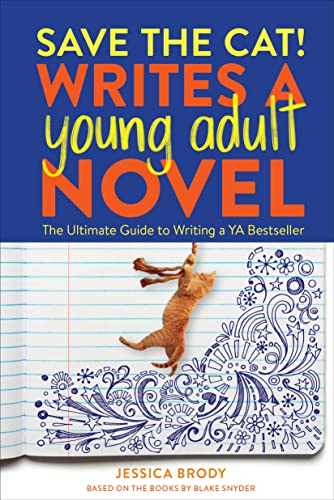
Book Review – Save the Cat Writes a Young Adult Novel


Save the Cat writes a novel completely changed my writing process for the better. So I decided it was time for a reread and I wanted to get a hard copy instead of an ebook, so I figured I’d pick up the YA version (since I write almost exclusively YA.) While I still find the plotting and the beatsheets to be incredibly helpful, I preferred the non-YA version. (It just felt more universal with sharper examples.) But I was glad I reread it to brush up on plotting tools, archetypes, and devices.

Since it’s a craft book, no star rating for this one.

All for saving the cat, but not super into the YA version.

Thanks for reading!
For Writers: Why was my manuscript rejected?

So I became a WriteHive mentor because I wanted to pay forward all the wisdom and experience the writing community had gifted me over the years. And since I’ve done quite a lot of beta reading, critique swaps with partners, and also worked with quite a few editors over the years, I felt pretty comfortable that I’d be able to help someone improve their manuscript.

But what I totally wasn’t expecting was everything I learned during the manuscript selection process. I hadn’t considered that this was the first time I was on the other side of an acceptance/rejection decision. And what it brought it really home for me was that authors had actually requested me as a mentor in their queries!🤯I was so completely flattered and blown away.

In this article, I’m going to break down how I narrowed the submissions to select my mentee, the materials I looked at, and the questions I asked myself along the way. I found this a very enlightening process and thought it might be helpful for others going through the querying or submission trenches. However, please keep in mind, everyone has their own methods for selecting manuscripts for both representation, mentoring, and publication. This was simply the process and realizations I had during mine.

Here’s a quick breakdown of how many submissions came in for 17 mentors:

140 submissions (a 52% increase over 2024 – yay!)

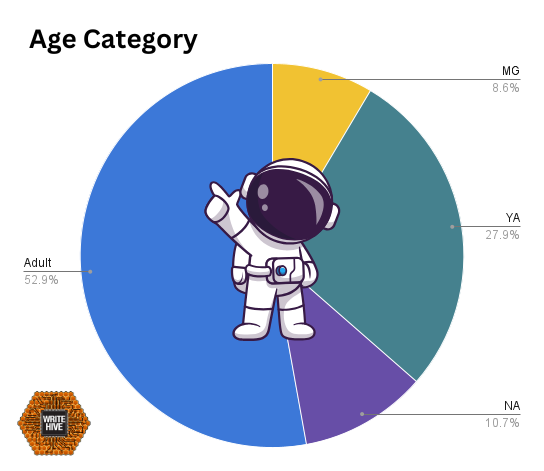
Age demographic submission breakdown:

  • MG: 12 (8.6%)
  • YA: 39 (27.9%)
  • NA: 15 (10.7%)
  • Adult: 74 (52.8%)

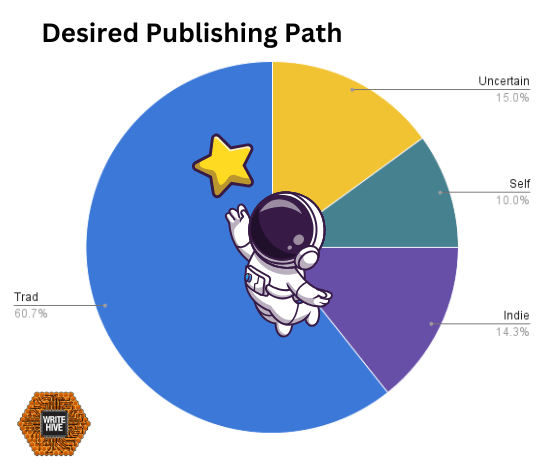
Publishing path submission breakdown:

  • Unsure about Publishing Path: 21 (15%)
  • Self Publishing: 14 (10%)
  • Indie / Small Press: 20 (14.3%)
  • Traditional: 85 (60.7%)

And genre breakdown:

  • Fantasy: 51 (36.4%)
  • Romance: 23 (16.4%)
  • Romantasy: 23 (16.4%)
  • Contemporary/Literary/Nonfiction: 17 (12.2%)
  • Horror/Suspense/Mystery: 16 (11.4%)
  • Sci-Fi: 10 (7.2%)

Each submission included their bio, the state of their manuscript (where was it in the writing process), pitch, their query letter, a synopsis, and their full manuscript. But how to narrow it down? I really wanted to make sure I picked the mentee who I could help most. A manuscript I could really fall in love with, but also one that I could help in a concrete way.

The first cut

So, even though I had outlined my general preferences in my MSWL (manuscript wishlist), I read the pitch, query, and first page of all 140 submissions, with one question in mind:

Does the premise grab me?

Based on that question alone (which, by the way, had *nothing* to do with the talent of the author or the quality of writing and everything to do with personal preference), I was able to cut my list down from 140 to 26.

That, in itself, blew me away. After all, I’ve received many rejections, and of course, every time, I assumed it was because I wasn’t a good enough author. My writing wasn’t good enough. The story wasn’t good enough.

But here I was, cutting 81% of the submissions with no regard to quality at all. Honestly, I probably could’ve done it based on the pitch alone.

Interesting.

So with that cut, my list was down to:
3/12 Middle Grade: 25%
9/39 Young Adult: 23%
2/15 New Adult: 13%
12/74 Adult: 16%
Total Longlist: 26/140

The Second cut

For there, I reviewed the bio, the state of the manuscript, their synopsis, and their query again. From these materials, the mentees included information on if they’d started querying it, which paths – traditional, small press, or self-publishing – they’d consider pursuing, and what they were looking for in a mentorship.

On my second cut, I was asking myself: Is this a mentee I can help? Am I the type of mentor they’re looking for?

Once again, I was not considering the quality of the story or writing at all. I was simply trying to ascertain at this point if we could be a good match based on my strengths and the kind of mentor they were looking for.

In the second cut I went from a longlist of 26 to a longlist of 12.

2/12 MG: 17%
3/39 YA: 8%
1/15 NA: 7%
6/74 Adult: 8%
Total Trimmed Longlist: 12

So at this point, I had cut 91% of the submission without considering quality of writing or story.

The third cut

The third is where I finally read the entirety of the first chapter and then asked myself: Am I drawn to keep reading? This is the first question I’d asked that could have been attributed to writing quality.

The third cut took me from a longlist of 12 to a short list of 7: 2 Young Adult Manuscripts and 5 Adult Manuscripts. From there, I read further into the manuscripts, and once again, this time, looking for the manuscript that I thought would be most suited to my tastes. In the end, I chose the story I had extremely concrete recommendations for, one which was very much suited to my personal taste, and had an author who was searching for knowledge areas I had. And just as an aside, only one of my top 3 choices showed up on another mentor’s top 3. For the most part, all of our top 3 choices were radically different.

So what’s the point?

When it came to publishing, I’d often heard the phrase “right eyes, right time.” Meaning essentially, that there are tons of quality stories out there, but you need to find the right agent/editor that’s the best fit to champion yours at the right time in the market. Which… comes down to a lot of factors outside of your control.

But once again, every time I faced a rejection, it was so easy to take it as a sign that I wasn’t good enough to be an author. Or the story wasn’t good enough to be published. But the truth is, writing, as an artform, is so personal. No one book is for everyone – and that fact is as true before publishing as after it.

So, if you submitted to the WriteHive mentorship, please don’t be discouraged in any way if you weren’t selected as a mentee. It really has no reflection on your ability as a writer or a storyteller, but rather simply, if your story was a good match for the mentors reading submissions this year.

And as I continue to trudge on in the submission trenches, I’m trying to keep the very same lesson in mind. That my stories need to find the right eyes at the right time. Whether that’s next week or next year or in three years really isn’t up to me. All I can do is be patient and keep writing the best stories that I can.

Hopefully, if you’re in the query or submission trenches, this has been helpful in some way and can also help you to find the mindset and perseverence you need on your writing journey.

Rejections are tough. There’s no two ways about it. Just remember to take care of yourself, take lots of breaks, and keep on keeping on.
Begin. Grow. Persevere.

Thanks for reading!

Giving back to the writing community

So, this year marks a new chapter for me as an author. Though still battling imposter syndrome (as I think most authors do to some extent), I’m making a conscious effort to give back to the writing community this year.

As such, I’m officially a judge for the WriteHive Indie Ink Awards! As a judge, I’ll be reading six books in the next six months, scoring them in a rubric and rating them in the categories they were nominated. Out of the nominees, I’ve actually already selected the six I intend to read and downloaded my first read. Best Audio Narration & Best Light Read are the two categories I’m feeling in this season of life, so that’s where I’ll be hanging out.

But personally, I’m a big fan of book awards as a way to distinguish and lift up authors (indie authors especially) and I’m so excited to be a part of it.

But that’s not all!

This year, I’m also a 2025 WriteHive Mentor! This is an extra special opportunity for me since I was actually a 2023 WriteHive Mentee with EJ Dawson as my mentor, and I learned so much! I was so excited to pay it forward, and even more excited to pick Erin Scheuer as my mentee. I absolutely fell in love with her rock star/celebrity romance Love Songs and Other Lies, (which reads JUST like a K-drama, you all—squeee!!!), and we clicked instantly on our first call.

She’s entering into the revision phase, and I’m so excited to see her take her manuscript to the next level. Everyone is absolutely going to love her sweet, complicated characters, and I’m so excited for the world to meet them! Check out the mock cover and moodboard I put together for her!

It was also super interesting to be on the other side of the submission/rejection process, and I learned quite a lot. (Separate post coming on that soon!)

All in all, this has been such a positive experience so far, and I’m so glad I was able to take the leap to jump into these opportunities! I’ll be posting the books I review for Indie Ink awards here just like any other book, but when the results come out I’ll definitely post an update on the winners! And of course, if anything exciting happens with Erin’s Love Songs & Other Lies, I’ll be sure to post about that too, because I’m pulling hard for it!

Thanks so much for reading!

Character Artist Recommendations for Authors

Okay, so this is the post I needed in my life as a budding author in 2019. I have always loved art since I was a kid, and now, as an author, I adore seeing books brought to life through character art, and use character art heavily when promoting my books. But when I first started out, I had no idea who to message about character art.

Over the years, as I admired other authors’ commissioned pieces, got recommendations from authors, and commissioned different artists myself, I began to gather quite a few art pieces of my books that I adored as well as a list of artists I enjoyed working with. I’m always on the look out for new artists and fresh styles, because I love to see how different people with different perspectives can bring to life characters in different ways.

And yes, I only work with human artists and likewise, human authors. In case you haven’t seen my thoughts on generative AI, you can find them in the graphic below.

So in part, this is an artist appreciation post for the artists who I’ve worked with over the years, and it’s also a resource for those other authors out there looking for (human) artists to commission. Without further ado, the guide is below! All handles are from Instagram unless otherwise noted.

NYC Midnight Challenge – 100 words – Second Round – A Revolutionary Lie

A Revolutionary Lie

June 2024 (Second Round)
Genre: Historical Fiction
Action: Stumbling
Word: Tour
Time Constraint: 24 hours
Length: 100 words

The wound may not be mortal, but it’s still the end of me.

Blood seeps from my shoulder as Holbrook stumbles to my side, the redcoat’s body cooling in the autumn leaves.

“How bad?” Holbrook rasps.

“I…”

But it’s too late; Holbrook’s already ripped open my coat and shirt. For a moment, he only stares, my lie exposed with the curved contour of my bound chest—Robert Shirtliff poised to die at the hands of his dearest friend.

“’Tis a small wound.” Swallowing, Holbrook pulls his spare shirt from his knapsack. “No one need know.”

And I am saved twice.


This one came in first (🎉) in its group, and the feedback is below!

WHAT THE JUDGES LIKED ABOUT YOUR STORY

2076}  I was impressed by the sense of the personal in this piece, the way you allow the historical context to be so in the background and this life-or-death personal catastrophe to come out so strongly in an emotional climax. I thought the last line was beautiful, with real literary flair.

{1666}  Excellent work here! Your narrative arc was full-bodied and complete, which speaks to your imaginative force and economy as a writer. The double-entendre of your opening line was really clever, and I appreciated your speculative additions to the known facts of this fascinating figure’s tale.

{2376}  This story has a strong sense of mystery with an excellent payoff. You do a great job of hooking the reader in with an opening line that presents the reader with an irresistible riddle. And the way that riddle is answered put the reader in the same position as Holbrook—with the truth slowly dawning us. And the final turn the story takes leaves the reader with a satisfying conclusion, having Holbrook make the same decision that we would make in his position.   

WHAT THE JUDGES FEEL NEEDS WORK

{2076}  What might be worth developing in this piece is your description. Can you rephrase it from our narrator’s perspective, drawing closer to their sensory experience in a more specific way? Think about when the blood is seeping from the wound; does it hurt, is the blood warm, is it numb? What does the redcoat’s body look like? What’s the setting like, what does Holbrook’s face look like? This will all immersive the reader more strongly in the moment at hand.

{1666}  While it’s clear enough to me that “Shirtliff poised to die” is a figurative statement, there are enough swirling elements and tension for this to be misinterpreted. The reader may be wondering if the narrator is referring to the existing wound, being killed by Holbrook, or facing some sort of death penalty after being exposed as a woman. Some alteration here might help protect the interpretation. Additionally, take a look at reworking sentence 2 – the clause “the redcoat’s body cooling in the autumn leaves” doesn’t refer or link to any other active image in the sentence, so the sparse phrasing feels affected just for the sake of sparing words.

{2376}  There’s a lot already going right in this story, but there are a few small things to consider in a revision. One would be reframing the line about the redcoat’s body. The way that this phrase is attached to the image of Holbrook stumbling to her side creates a little confusion in this draft. Spliced on, the reader is expecting this clause to modify some part of the sentence we’ve already read. Instead, if Holbrook “stumbles over the body of a redcoat cooling in the autumn leaves” we get the image of the dead man without the confusion. Another thing to consider would be taking out the line about Robert Shirtlff dating at the hand of his friend. This line tells us what the story is showing us about the closeness of these two people. It also interrupts the moment of tension in which or POV character is left wondering what’s going to happen. Instead, you could sustain this tension by having Holbrook pull out his spare shirt before he speaks, leaving the reader unsure of what he thinks until the last possible moment.


Thanks for reading! You can find the rest of my NYC Midnight Challenge entries and feedback here.

NYC Midnight Challenge – 100 words – First Round – The Tearstains Left Behind

the tearstains left behind

April 2024 (First Round)
Genre: Drama
Action: Throwing a Tantrum
Word: Deal
Time Constraint: 24 hours
Length: 100 words

I can only stare as the front door slams and Chloe runs after her mother. Already screaming, Chloe pounds the wood with chubby three-year-old fists until she melts into a hysterical puddle on the floor. I want to tell her it’ll be okay; her mother will come back. My daughter will come back.

But those lies won’t change the hand we’ve been dealt.

Instead, I sit beside her, my tears adding to the splotches Chloe’s already made on the linoleum. “I’m here.”

It’s all I can offer, but when her dimpled hand squeezes my wrinkled one, I know it’s enough.


This one came in first (🎉) in its group, and the feedback is below!

WHAT THE JUDGES LIKED ABOUT YOUR STORY

{2370}  You did a great job at portraying the scene, providing great imagery and details (chubby fists, tears on the linoleum), and provoking intense emotions in your reader. You only had a few words to work with, and you did a really great job.

{2314}  There’s great subtlety at work here. Obviously Chloe’s responses are dialed up. In contrast, our narrator is subdued, a person who perhaps has dealt with grief before a few times in their life. It works well.

{2369}  This story is heartbreaking. That poor baby. And poor grandparent. The emotions of this piece are spot on and well done. Every word does work and is needed. A vivid story that is well told.  

WHAT THE JUDGES FEEL NEEDS WORK

{2370}  One minor suggestion is that I don’t think you need to say “three-year-old fists.” I think you could change that to toddler or just say chubby fists. We can infer her age thanks to other descriptions you include and through Chloe’s behavior.

{2314}  I found myself feeling this story is good – when it has the potential to be great. I think it’s in the details. You’ve given us a broad scenario – family dealing with grief. Refracted through an older person, dealing with a younger person. I found myself wanting some other x factor – either in style, or characterization, to elevate the premise. 

{2369}  There’s not much of anything I would suggest for improvement. This story is easy to understand but has enough depth for the reader to feel something. My only thought is that 3 seems a bit young for Chloe to understand and be able to do anything other than cry and throw a fit for her mama. You don’t say she does understand, but somehow it still feels that she does. The image of a dimpled hand squeezing a wrinkled one is so beautiful that I hesitate to ask you to change it, so maybe consider making Chloe just a touch older?


Thanks for reading! You can find the rest of my NYC Midnight Challenge entries and feedback here.