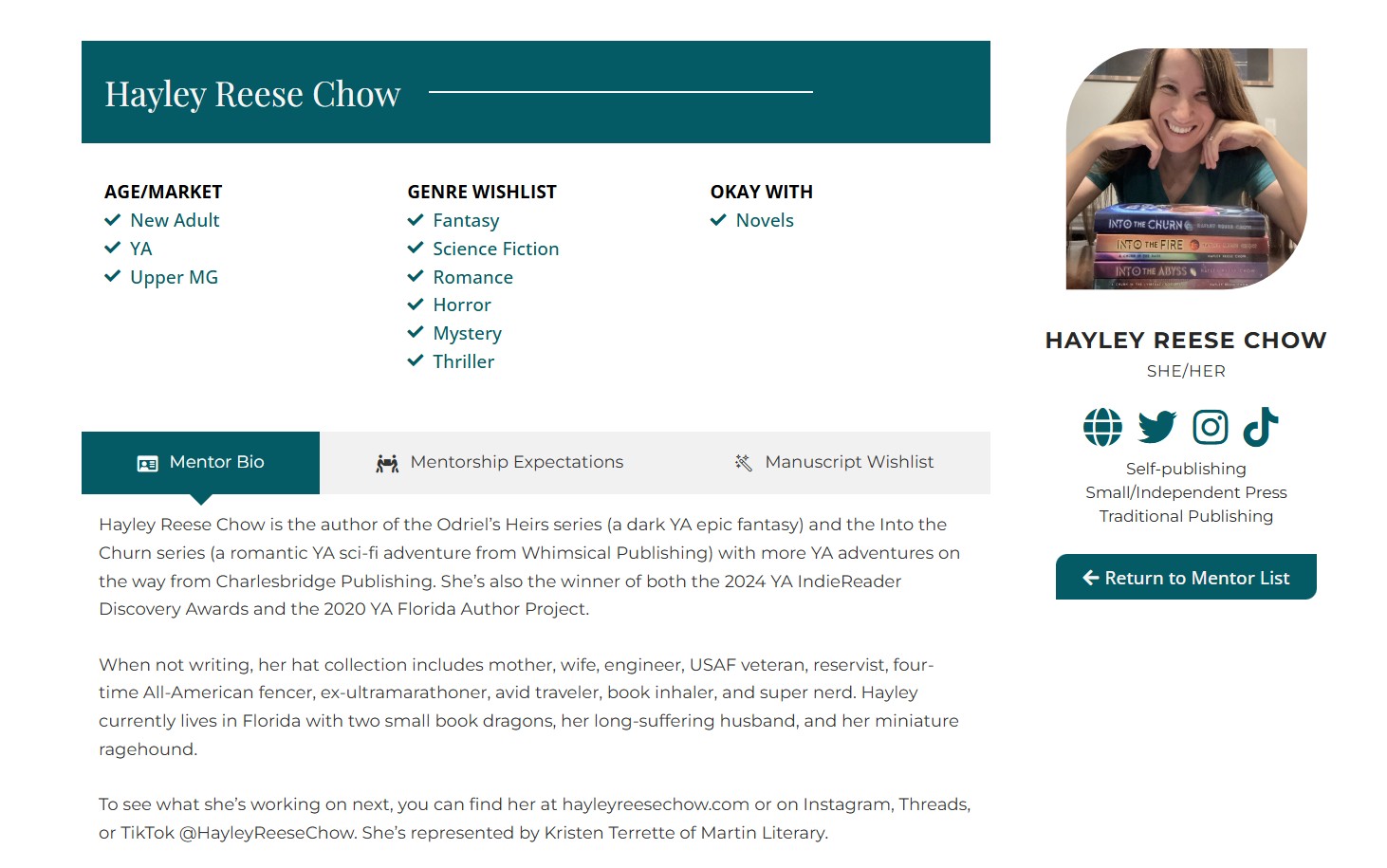
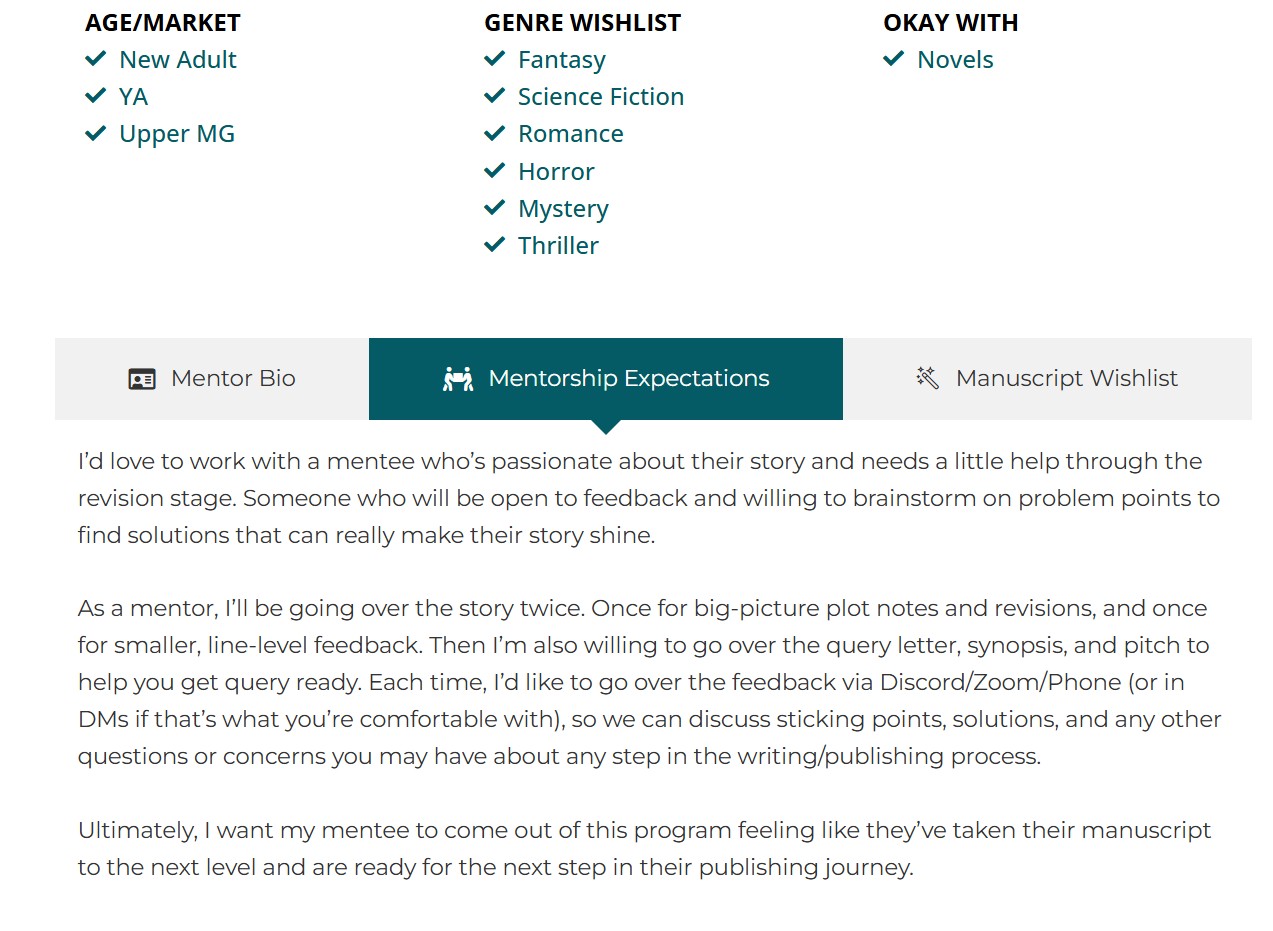
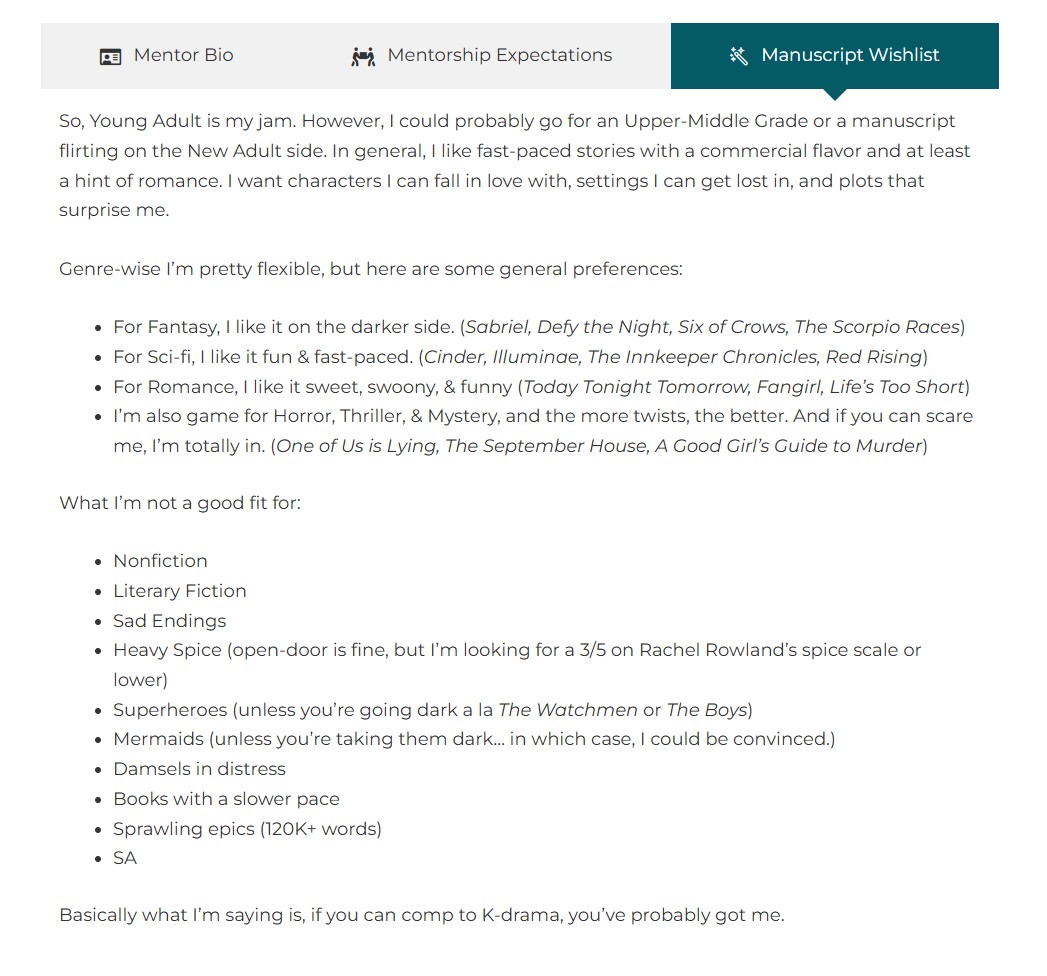
I’m so excited to announce I’ll be returning to the WriteHive Mentorship Program for my second year as a mentor. I had a great experience as a mentee in 2023, and again as a mentor in 2024, so I highly recommend this program to anyone looking for some help in whipping their manuscript into shape! I’ve included my mentor wishlist, profile and expectations below, but I highly recommend you check out all the mentor profiles here.
While you don’t submit to a specific mentor, I found it super helpful last year when applicants listed a few mentors they thought would be a good fit in their query/submission letters.
Also, if you’re curious as to what I’m looking for in submissions, you can find my breakdown of the submissions from last year here.
Last year, I went with Erin Scheuer‘s sweet new adult romantic comedy with YA crossover appeal which had huge K-drama vibes that I absolutely adored. But honestly this year, I’m pretty open when it comes to target audience and genre. There will be a Mentor AMA on WriteHive’s Discord & Bluesky next week if you have more questions, but if you’re on the fence about submitting, I hope you decide to take the leap!
Submissions will be open from Nov 14-16 and I can’t wait to see what comes in. If you’re submitting, good luck, and I’m excited to read your pitch!
So, this year marks a new chapter for me as an author. Though still battling imposter syndrome (as I think most authors do to some extent), I’m making a conscious effort to give back to the writing community this year.
As such, I’m officially a judge for the WriteHive Indie Ink Awards! As a judge, I’ll be reading six books in the next six months, scoring them in a rubric and rating them in the categories they were nominated. Out of the nominees, I’ve actually already selected the six I intend to read and downloaded my first read. Best Audio Narration & Best Light Read are the two categories I’m feeling in this season of life, so that’s where I’ll be hanging out.
But personally, I’m a big fan of book awards as a way to distinguish and lift up authors (indie authors especially) and I’m so excited to be a part of it.
But that’s not all!
This year, I’m also a 2025 WriteHive Mentor! This is an extra special opportunity for me since I was actually a 2023 WriteHive Mentee with EJ Dawson as my mentor, and I learned so much! I was so excited to pay it forward, and even more excited to pick Erin Scheuer as my mentee. I absolutely fell in love with her rock star/celebrity romance Love Songs and Other Lies, (which reads JUST like a K-drama, you all—squeee!!!), and we clicked instantly on our first call.
She’s entering into the revision phase, and I’m so excited to see her take her manuscript to the next level. Everyone is absolutely going to love her sweet, complicated characters, and I’m so excited for the world to meet them! Check out the mock cover and moodboard I put together for her!
It was also super interesting to be on the other side of the submission/rejection process, and I learned quite a lot. (Separate post coming on that soon!)
All in all, this has been such a positive experience so far, and I’m so glad I was able to take the leap to jump into these opportunities! I’ll be posting the books I review for Indie Ink awards here just like any other book, but when the results come out I’ll definitely post an update on the winners! And of course, if anything exciting happens with Erin’s Love Songs & Other Lies, I’ll be sure to post about that too, because I’m pulling hard for it!
If you’ve been reading my review posts this year, you’ll have noticed that for (what seemed) like a long stretch, I was in a huge reading slump. Meaning that it seemed like I kept picking out and reading books that weren’t for me. Now, this is almost certainly due to several reasons: environmental factors, mood, and also my desire to read all the books on some random “most popular series list” I found.
And honestly… I probably should’ve DNF’d (do not finish, i.e. gave up reading) a lot of them. Before this year, I tried not to DNF. I have a Goodreads reading goal of 60 books a year. While I’m not married to it… it does still stick in my mind. So when I’ve already invested an hour-plus into a book, it’s hard for me to give up on it. And then there’s always the FOMO (fear of missing out) that MAYBE the book gets better and turns out amazing.
But, through my reading slump, I found that was *rarely* the case. So, I started trying to come up with a way to encourage myself to put down books I wasn’t enjoying. After all, there are SO many books out there, why spend time on the ones not for me?
At first I tried, “If I’ve thought about DNF’ing it twice, it’s time to DNF.” And I think this works well for when the book isn’t working for me somewhere in the middle, but honestly, I found that wasn’t strong enough. I was still reading books that didn’t HOOK me—books that didn’t make me WANT to read.
So recently, I’ve also decided 10% is my benchmark. (As a audiobook reader, this is easy to gauge, but it’d be easy for a print book too.) If at 10%, if I am not LOVING a book—if I’m not actively looking forward to reading it—then it’s not for me. It seems like a high bar, but honestly, I’m tired of reading books that aren’t a good fit. I want to get to the point where I *only* finish books I can rate at four stars or higher. Heck, if I only finish five stars books—even better!
Because there are millions of books out there, and thousands of books I know I will 5-star LOVE, so why settle for anything else?
That said, it means that I may not make my reading goal for the year, I might post fewer reviews (because I don’t review books I don’t finish), and it means that I will be starting a lot of books that I don’t end up reviewing. But that’s okay. I’m writing this to hold myself to the conviction that it’s not about the number of books you read in year, but finding the books you love.
And if you needed to hear this too, then let this be your sign. If you’re not loving that book you’re reading, put it down and move on.
Just my half a cent, but I seriously needed a change, so we’ll see how it goes!
I received a request on Instagram to post about my writing process, so here we go! If you’re struggling to get started on a book or find your own rhythm, I hope you might find this useful, but please remember that everyone’s process is unique, and I encourage you to use whatever process feels right to you!
I also put how long I spend on each step so you can compare the level of effort between phases, but please keep in mind, that everyone’s pace is different. Also, that time estimate doesn’t include “thought time.” Believe me when I say I’m constantly thinking about these books, but as a full-time engineer and with two small kids, I try to be as efficent as possible. So when someone once told me that writing is “90% thought and 10% getting words down on paper,” it totally changed how I juggled works-in-progress (WIPs.)
I’m not the fastest writer and I’m not the slowest, but I’m a lot faster writer now than I was 12 books ago, some in part due to the streamlining of my process.
A plot seed
So, of course, it all starts with an idea. For me, they usually come at the most random times. When I’m about to fall asleep (looking at your Inky & Heater), in the middle of another book (Hi, Ninth Circle, thanks for being here), with a microfiction that just begs to be a novel. (Future Whimsical Title TBA, I’m talking about you here), or just an idea that’s been marinating for a long time. (Into the Churn series, this is you.)
No matter how it drops into my lap, I’m almost always in the middle of another writing project, and if I lose momentum, I suddenly turn into an upside-down turtle who has no idea how to get started again. So, I jot it into a doc and toss it into my folder called “Plot Seeds” along with any other specific notes.
The important note here is to WRITE THEM DOWN. Had a dream that could be a great book? Get out of bed and type them in the notes on your phone. They may not grow into anything, but if you forget them, they’ll never even have a chance. I have lots of plot seeds (at least 12+ sitting in the folder now), and many won’t grow beyond that, but at least they’re present and accessible. Some might even feed into elements of other books.
Ultimately though, if the plot seed is destined to become one of my book babies, then it’ll probably linger in my brain space—popping up during long drives and runs—and eventually, I’ll have too many details for a bullet. So, then we move to the next step.
Time: 2 minutes. You already have it in your head so just write it down!
Save the cat outline
At this point, I’m still probably juggling three other WIPs, so I don’t have time for this sucker, but I’ve GOT to get it on paper. So, I take out my Save the Cat beat sheet, write the one-page outline of whatever plot is keeping me from sleeping at night, and throw it in the plot seed folder.
*Cue sigh of relief.* Phew, that feels good.
Right now, I have five of these in my folder. I have doubts that I’ll write two of them for different reasons (I don’t feel super drawn to one and the other is a sci-fi, which I ADORE, but sci-fi is too hard of a sell right for me to justify it. And no, I’m still not over it.) But I’m desperate to write the other three, and two are on my schedule to be drafted in 2024.
The Save the Cat Outline lets them sit tight until it’s their turn to be drafted, and if any other details come to me at random times (character names, backstory, heck, I even have commissioned art in this folder, and character references for future art) I have somewhere to put them to keep safe until I’m ready.
Time: 1-2 hours. You’ve been thinking about it for a while, so it’s mostly fully fledged, just write it down so you don’t forget it.
percolate with playlists
So, now that I have a plot and probably have some idea of the characters, but its waiting its turn, now we help it percolate! Playlists are my favorite way to do this. They help to inspire me, switch gears between stories easily, and let me daydream the story in the little pauses of my life.
Right now, I have three full playlists built that correspond to those outlines. Of my five outlines, four that have been percolating since early 2022, and one relatively newer one since early 2023. There is no time requirement to percolate, however, because of how I schedule, this is just how it works out for me.
Time: As long or as little as you need.
Zero draft
This is the point where I’ve decided I’m going to write it. If I zero-draft it, I’m going to feel compelled to keep it. I try to prioritize the outlines I’m both epically drawn to and also ones that make sense from a strategic/marketing perspective.
For me, a zero draft is literally me telling myself the story in almost exclusively dialogue. Basically, it reads like a screenplay. But sometimes, because I have no self-control, it can get a little out of hand, and every time I do this step, the drafts seem to get longer. (Mostly because I’m just DYING to really write the story at this point.)
I currently have one zero draft in my folder and it’s at 17k words for what will eventually be probably a 70k book. This is also usually where my moodboard, mock cover, and character inspirations also come in—because I am EXCITED.
Time: 1-2 weeks
First draft
This one’s pretty self-explanatory. Now we get to write the book! With the zero draft in hand, this usually moves pretty quickly for me. I can put in as many as 50K words in a month depending on how much other stuff I’m juggling in my non-writer life, but I usually budget 3 months to be on the safe side.
What’s important (for me) here is to focus on completion and momentum, not perfection. No one will see this draft but me. Even if it’s terrible, remember that everything is fixable, but you can’t revise a blank page. If you need to disappear a character/element/change a setting, just move on as if you’d already written it like that. Don’t go back. Don’t edit. Get the story down, and we’ll fix it post!
For the record, I’m a consistent underwriter, so I don’t freak out about too much about wordcount at this point. (My first draft is usually like 10-15k work less than the final draft) I go through tons of revisions rounds, and with each one I’m adding a new layer to the story. Everyone is different, and it’s nice to be in the ballpark with word count, but remember *everything* is fixable.
Time: 2-3 months.
revisions
Rev A
So in general, for me, individual revision rounds are quick. In each revision, I basically make one quick pass of major changes and one slow pass to catch all the details. With this first revision, my primary goal here is to make it readable and consistent for another pair of eyes.
Then I send it to Alpha readers. (This is my parents and my husband. They will read anything I put in front of them but also be honest about what they do and don’t like.)
While I’m waiting for their feedback, this is also where I write the synopsis (this is my favorite formula) and the blurb. They help focus me on the themes and overarching plot so I can really hone the beats and character development.
Time: 1 week for the revision and then waiting for 2ish weeks for feedback. Whenever I’m ‘waiting,’ I’m always working on another WIP.
Rev B
After I get Alpha feedback, I take two more passes to make the necessary plot changes, refine the characters now that I know them well, and start layering and smoothing.
Then I send it to two critique partners (CPs) and 3-4 beta readers. I used to do this in separate steps but have combined for efficiency’s sake. My CPs are fellow writers looking for EVERYTHING big or small, from line level to large plot changes. Although working with them isn’t time intensive, the process usually stretches over several months. I rely on their unique perspective, objectivity, and different strengths to help me see things I wouldn’t be able to by myself.
In tandem, I send the book to 2-3 professional beta readers and 1 casual beta reader friend for their big-picture impressions.
Time: 1 week for the revision… and then 4-5 months working with CPs.
Rev C
This is where I gather all the beta reader feedback and do a large revision (usually while I’m still trading chapters back and forth with CPs in the background.)
Time: 1 week
Rev F
The critique partners are done! Hurray! Time to do one last read-through for line-level smoothing before I send it to my agent or Whimsical Publishing. In this step, I start using MS Word’s read-aloud function to listen for typos and flow issues, and will continue to do so for the remainder of my revisions. (And if you’re looking for Rev D, I don’t have one. I used to call this round F for final, and it’s stuck that way now for me.)
Time: 1 week
Rev G
Now, we get to start over! XD Okay, I’m kidding. (Sort of.) Now, I’ll go back and forth with my agent, Kristen, or Whimsical until it’s ready. How many revisions is this? Honestly, as many as it takes, but three’s usually the magic number. The first one is for big plot things, the second is for minor plot things, and the third is for line-level things.
Each revision takes me about a week, but then I have to wait for them to read it, so this phase will stretch out.
Time: 2-3 months
Rev Z
For Whimsical this is where the copyeditor comes in, and we go back and forth again! But these are once again, smaller line-level changes and proofing levels.
Hypothetically, when my agented books find a home, this is where I would work with the publisher to start all over again! (Joking… kind of.) But since I haven’t gotten that far yet, I’m not sure of the timeline
Time: (For the Whimsical copyediting portion) About 2-3 months.
Then ta-da, it’s done!
So, all the timelines ended up being kind of confusing with the waiting and the actual doing portions. But in reality, I’m never waiting. Because as soon as I put down one manuscript to wait, I’m picking up another. Hence why I always juggle more than 1 WIP, which also confuses the timeline! And it’s also why I’m constantly updating my schedule.
Behold. The schedule!
In any case, please keep in mind these timelines are just a rough guess anyway and will vary with each book.
For Inky & Heater: IRL (which is currently on sub with my agent) I started the first draft on Nov 1, 2022, and it went on sub (roughly) on Sep 2023. Which is about 10 months from the Draft 1 to the end of Rev G (and included querying time.)
For Into the Fire (which is scheduled to launch May 2024) I started the first draft in (roughly) May 2023, and I just completed Rev G. Which is about 8 months from Draft 1 to G (no querying time for this one.)
And for more reference, between 2020-2023, I wrote ten books. If you count my two novellas and one co-authored book as a single 80k-ish-word novel, it’s more like eight books. So, I’m averaging two books a year. Like I said at the beginning, I’m not the slowest or the fastest, and I’m sure my process will continue to evolve, but for now, this is what works for me! By hopping between works-in-progress while I ‘wait’ for feedback, I can look at each revision with fresh eyes while also maximizing my efficiency. And by the end of this process, I feel confident like my book is the best I can make it, and I’m proud to call it mine.
So, yeah. Hopefully, this was helpful, and I hope you also can find the writing process that works best for you and your book baby! As always, if you have more questions, just let me know!
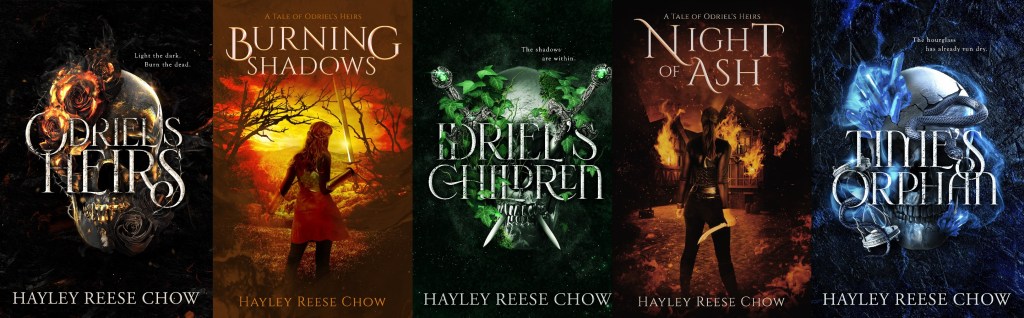
So, I’m not a musically inclined person by nature, but I decided to try to make some playlists for my books, and I absolutely loved it! Listening to the playlists added this whole other dimension and put me right into the book so I could experience the scene play out. So cool! Naturally, since it was so awesome, I had to share. Below, are the playlists for the entire Odriel’s Heirs series, and I’ll be sure to add them to their page on this site. I’ll also release the playlists for Codename: CNDRLA and my 2023 sci-fi closer to publication!
I hope you enjoy them and as always, I’d love to hear your suggestions and recommendations if you have any!














 Hayley Reese Chow