For writers: The ups & downs of being on submission

Look it’s me in the query… I mean submission trenches! 😂

So, the first rule of being on sub is that we don’t talk about sub. But, instead of talking about the specifics of my sub journey, I’m really just going to talk about the general vibes of being on submission. Because it’s definitely come with some surprises for me. Please keep in mind this is my own personal take based on my experience, which may or may not align with anyone else’s.

The good

  • Your agent believes in you and your story! This is huge!
  • The doors to the big publishers are open and your agent is championing your story! This is also huge!
  • You no longer have to spend valuable writing time sending out queries
  • So… you get more writing time! Huzzah!

The less good!

  • The stakes are higher. Think of it as climbing higher up a mountain and having farther to fall. (Because now your agent is also depending on your books to sell. And, if they don’t… well you might end up back in the query trenches.)
  • There’s more hope, and so also more disappointment. If you’re going to ride this roller coaster, mental toughness is a must.
  • Submission response times are longer than query response times (in my experience.) So be prepared to settle in and get comfortable

My Advice

Pessimist?

This is going to sound a lot like the querying advice article I wrote a couple years ago, and mostly these reminders are for me.

  • Try to keep your expectations low. Because even though I have an agent, my book still might not sell. And why you might call me a pessimist, it’s how I keep myself from getting crushed with those near misses. In the querying phase, I treated query letters like lottery tickets, and I need to treat submissions in the same way.
  • Have a rough idea of what you would do if you lost your agent. Would you self-publish your manuscripts or query a fresh book with your backlist in tow? I honestly have no idea what I would do, and I think that’s part of my current mindset problem.
  • Work on something else while you wait! This is common advice, but for good reason. Time goes a lot faster when you’re excited for a new manuscript. And this part, at least, I’ve got down. In the span of fourteen months, I actually sent my agent six manuscripts… which leads me to the next piece.
  • Find other ways to grow and learn as a writer. For me, in 2024, this looked like diving into craft books and signing up to be a mentor in the WriteHive Mentorship Program. But in 2025, I’ll be looking for different opportunities to explore. Conferences? In-person events? Marketing classes? I’m definitely open to ideas and recommendations
  • Trust the process (and your agent) and stick with it.

so what’s the bottom line

Being on sub can be difficult, just like querying can be difficult. But just because it’s difficult doesn’t mean it’s not worth doing. Try to enjoy the journey, even through the ups and downs, and the stories will find their way out into the world one way or another.

Cheers to the tenacity of being on sub and whatever comes next. Good luck out there!

How to get started with Audiobooks

So, I’ve been hooked on audiobooks for years now, and I recently got a question from reader trying to get into them, so I figured I’d drop some tips.

I was first inspired to read audiobooks by Stephen King’s book, On Writing. With two elementary-school kids, a full-time job, and trying to write my own books, finding time to sit down and read was challenging.

But audiobooks opened up a whole new world of multitasking. Not to mention I was completely blown away by how much a narrator could bring the story to life, adding a completely new dimension. (And, as a bonus, I know how to pronounce all of the characters’ names right. 😂) Now, years later, I read 50-70 books a year, and about 95% of them are audiobooks.

So here’s a little guide to getting started in this format!

Where to find audiobooks (for free)

When most people think of audiobooks, they go straight to Audible. But… at $8 or $15 per month (as of this writing), Audible’s kind of expensive. While I recently got a subscription for a specific book series, I don’t have any intention of maintaining it. But, if you don’t have an Audible subscription, individual audiobooks can run you $20 a pop (eek!) Thankfully, there’s a better way!

Most local library’s now allow you access their audiobook collections with your library card number & the free app, Libby. This is where nearly all of my audiobooks come from.

If you’re a NetGalley reviewer (or would like to sign up to be one), you can also grab free audiobooks from their site in exchange for an honest review. Their audiobook selection pales in comparison to their ebook listings, but I’ve snagged a few listens.

Also, there are a few sites where you can grab free audible promo codes posts by narrators and authors. I have used a few of these as an author, but not really as a reader. Some of them also require that you leave a review in exchange for the code.
AudioFreebies.com
FreeAudiobookCodes.com
AudiobooksUnleashed.com

The last reliable audiobook source I can think of is Spotify. A Spotify Premium subscription gets you access to their library of audiobooks, but as Spotify is also expensive ($11.99 a month) and I can’t speak to the size of their collection, I’d only recommend this if you already have a subscription.

Bottom Line: Your best bet is to get a library card from your local library, download Libby on your phone, and BOOM. So many free audiobooks at your fingertips.

A note on the listening skills & listening Speed

When I first started listening to audiobooks, it was legit hard for me. I consider myself a visual learner and honestly I would rather read a transcript than watch a video. But, as someone who was looking down the barrel of a 24-hour out-and-back roadtrip, I was desperate.

So I persisted, and lo and behold, my listening skills improved. And when I got better at absorbing information through listening, it actually helped my professional life too. (Think meetings and telecons.)

But, if you’re a podcast listener, good news, you’re already there, and it’s only a small jump to the world of audiobooks!

One thing that did *DRASTICALLY* improve my audiobook listening experience was figuring out I could adjust the narration speed. I quickly learned that one of the reasons I was having trouble concentrating was the narration speed was just too slow for me. When I upped it up to 1.5x, it felt much more natural and kept my attention. And, after many years of my listening skills improving, I now comfortably read audibooks at 2.5-3x (depending on the narrator.)

Basically what I’m saying is, be sure to adjust the listening speed until it’s comfortable for you! (You can even make it slower – everyone is different!)

Bottom Line: Be sure to adjust the narration to a comfortable speed, and give your listening skills 1 or 2 books to get warmed up before you give up on the audio format.

When do I listen to audiobooks?

Basically anytime I can pop my earbuds in or when I don’t have anyone else competing for my listening-attention. In order of time spent listening:

  • Driving to & from work
  • Traveling (roadtrips or flying)
  • Watching my kids’ sports practices (they love when I watch them, but don’t mind if my earbuds are in.)
  • Chores! Mowing the lawn, doing the laundry, cleaning/tidying the house, doing the dishes… etc.
  • Exercising (especially running & lifting weights)
  • Walking the dog (Tula loves when I’m listening to a good book, because then we go on lots of walks 😂)
  • Waiting in line anywhere (seriously, as long as I have my earbuds, I’m happy)
  • Grocery shopping (or really any kind of shopping.)

Bottom Line: I’m so hooked on listening to audiobooks during my commute I actually start to get antsy when I don’t have one downloaded.

But what audiobook do i start with?!

Okay, well now that’s a seriously hard question. My advice is start with your favorite genre, and pick one you’ve been dying to read or that sounds absolutely amazing. If you’re still fresh out of ideas, here’s a few recommendations to get you started. And if I missed your favorite genre, let me know in the comments, and I’ll see if I have a recommendation to add in. Or you can check out my book reviews links here (which I try to update annually) to peruse one that sounds good. Good luck with you audiobook journey, and I sincerely hope you love them as much as I do!

Middle-Grade Fantasy: A Wizard’s Guide to Defensive Baking

YA Fantasy: Where the Dark Stands Still
YA Sci-fi: Illuminae
YA Romance: Today, Tonight, Tomorrow

Fantasy: Swordheart
Sci-fi: Dark Matter or Recursion
LitRPG: Dungeon Crawler Carl

Contemporary Fiction: Anxious People
Romance: Book Lovers
Romcom: The Soulmate Equation or Life’s Too Short
Mystery/Romance: A Bad Day for Sunshine

Historical Fiction: Small Mercies
Nonfiction: Outliers: The Story of Success or The Devil in the White City

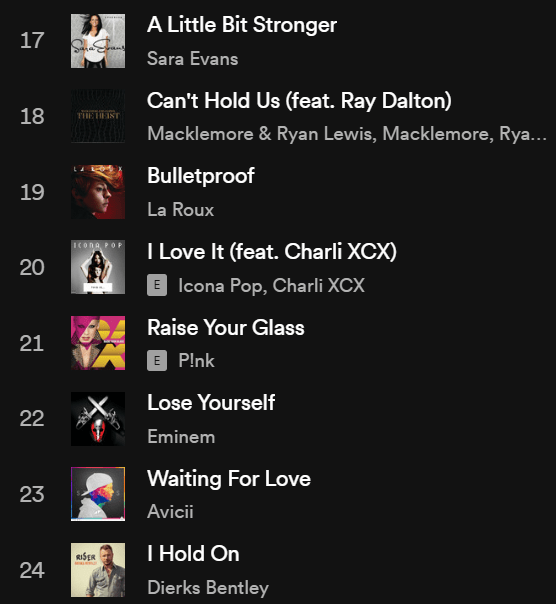
How to Deal with Rejection – A Playlist

Let’s talk about navigating rejection and negative feedback for a second. Honestly, it was something I’d never really thought about before I wrote my first book (mostly because I didn’t actually think I’d ever publish it.)

Fast forward a minute to first readers, betas, critique partners, editors, queries, and then reviews. Whoa! Negative feedback non-figuratively everywhere!

So how do you keep writing with someone calling your book baby ugly from the second it’s born until quite possibly… forever?!? How do you keep submitting when you’re getting truckloads of rejections? Well, here are the tips I can offer:

Pre-Publishing Feedback

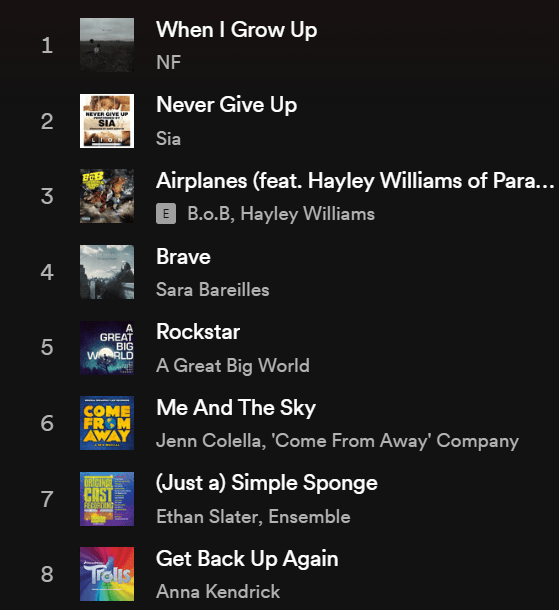
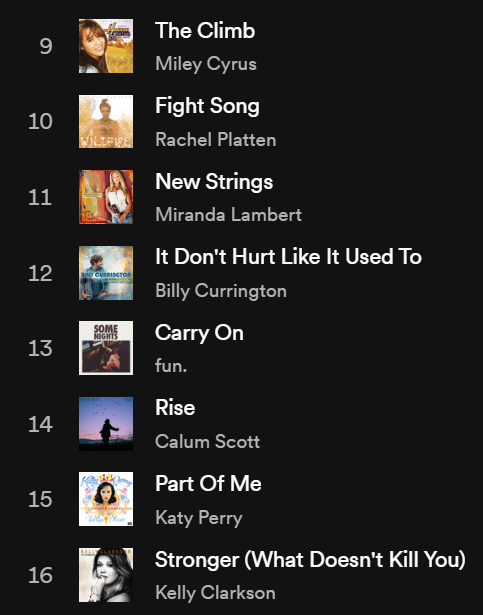
  • Put on the playlist. (see below)
  • Let the feedback sit and percolate. Trust me, it’ll sting less the second time, and you’ll be able to more objectively see the changes you do and don’t want to make.
    • After I got the development edit back on my first book, I had to let it sit for three months before I gathered the energy to re-attack. (The feedback was BRUTAL 😆)
  • Trim the feedback to actionable bullets in your own words. It’s less overwhelming than big blocks of text, and you can cross them off when you’re done.
  • If you’re not sure if you want to accept the suggestion, ask another beta reader. If one beta thinks it’s a problem, it’s an opinion, if two betas think it’s a problem, it’s a problem. Just make sure you’re asking betas you can trust to be honest.
  • Just because you accept it’s a problem, doesn’t mean you have to accept their suggested solution. There are a million ways to address a problem. Always revise in a way that feels right to you.
  • Find critique partners and beta readers you can trust and build the relationship over time. The more trust there is between you, the more honest you’ll be with each other, and the more fun it’ll be!

Rejection

  • Put on the playlist. (see below)
  • Delete it! (After you log it in your querying excel sheet and hide that row, of course.) There’s no reason to linger on it, so get it out of your headspace as quickly as possible.
  • Reach out to a writing friend for support – they will understand.
  • Work on a different manuscript. All your eggs are not in one basket! Have many baskets!! BE THE EASTER BUNNY OF EGGS.
  • Know that: 1.) all writers have been rejected, and 2.) it will get easier. I can safely say I’ve received hundreds of form rejections. They still sting a little, but WAY less than they used to.

Post-Publishing Feedback (i.e. Bad Reviews)

  • Put on the playlist. (see below)
  • Remember the silver linings for 3 stars and below:
    • 3 stars: As a reader, these are the reviews I read before I buy a book. They usually list things they did and did not like about the book and can be very helpful. And as a writer, I have definitely used and grown from 3-star feedback.
    • 1 & 2 stars: Sure, your book wasn’t for them, but your book managed to reach people outside of your friends and family! That’s a huge win for exposure, and there’s no popular book that doesn’t have these, so try to treat it as a rite of passage.
  • Reach out to a writing friend for support – they will understand.
  • Pull up the Goodreads page for your favorite book ever, read the 1-star reviews, and have a laugh.
  • Reread your good reviews. Don’t let that single 1-star review negate those dozens of 4 and 5 stars. There are 8 billion people in the world and counting, no book is for everyone!
  • Rejoice! Someone read your book and took the time to review it, and in many instances, the number of reviews is more important than the average rating.
  • Work on your next book. Because you’re still growing as a writer, and this is only the middle of your journey. Rest if you need to, and then keep on going.

Oh, and don’t forget to jam while you’re at it:

And if you have any song suggestions, I’d love to hear them!

As always, thanks for reading! If you have any questions and thoughts, I’d love to hear them in the comments!